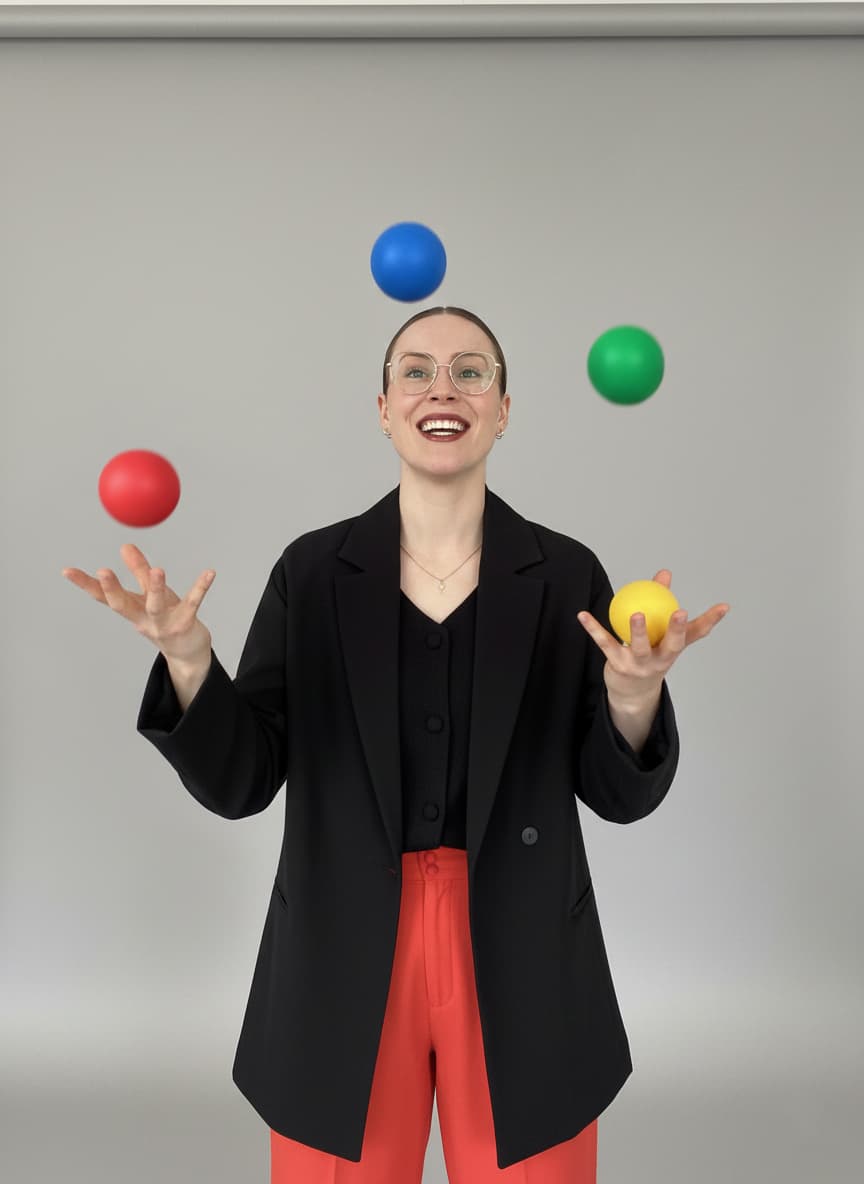
Hello and welcome!
I'm Sarah, and this is my little corner of the internet. Here you'll find a snapshot of the work I've done across medicine, AI research, teaching, and the occasional creative project.
If you'd like to work together, I'd love to hear from you.
Bridging AI and medicine.
Originally from Sydney, Australia, I moved to Germany in 2014 to study medicine. Since completing my medical degree and obtaining a German medical licence in late 2021, I have worked across clinical practice, medical education, and research.
Driven by a strong interest in artificial intelligence and a commitment to lifelong learning, I pursued a Master of Science in Applied Artificial Intelligence alongside clinical work. My current research applies computer vision to enhance the clinical utility of echocardiography in paediatric cardiology — focusing on patent ductus arteriosus, pulmonary hypertension, and aortic stenosis.
With my master's degree and doctoral thesis nearing completion, I am seeking opportunities to apply and further develop my clinical and technical expertise. My long-term goal is to contribute to the development of safe, reliable, and clinically meaningful AI systems that expand access to high-quality medical expertise and improve patient outcomes.
My current toolkit.
A career built at the intersection.
Click on the arrows to read more about each role.
Driven by curiosity.
Click on the arrows to read more about each qualification.
German university grades run 1.0 (highest) to 5.0 (fail). My MSc average of 1.3 is equivalent to a High Distinction average in the Australian grading system. My medical degree grade of 2.5 is equivalent to a Credit – Distinction average.
Funding & Awards.
Click on the arrows to read more about each award.
Publications & Conferences.
Click on "Abstract" or "View DOI" to read more about each entry.
Longitudinal Echocardiographic Severity Scoring for the Prediction of Chronic Lung Disease or Death in Neonates with Patent Ductus Arteriosus (PDA)
Long SE, von Fritschen M, Brower-Rabinowitsch H, Hohmann D, Uden T, Peter C, Beerbaum P
Deep Learning-Derived Myocardial Strain in Children: Validation of a Fully Automated, Open-Source Model for Left Ventricular Global Longitudinal Strain Inference
Brower-Rabinowitsch H, Long SE, Hohmann D, Uden T, Beerbaum P
Automated Selection and Annotation of Unstructured Pediatric Echocardiography Reports Using Llama-3.1-8B-Instruct, a Locally Run Large Language Model
Long SE, Uden T, Jabarulla MY, Oeltze-Jafra S, Beerbaum P
Artificial intelligence for patent ductus arteriosus — a systematic review
Long SE, Uden T, Peter C, Oeltze-Jafra S, Beerbaum P
A guideline-informed language model for paediatric cardiology demonstrates high performance in answering complex medical questions
Uden T, Jabarulla YM, Jack T, Avsar M, Bertram H, Happel CM, Hohmann D, Horke A, Junge C, Long S, et al.
Open Educational Resources in Otorhinolaryngology
Degen CV, Schwitzing F, Long S, Gickel L, Behrends M, Busch CJ, Steffens S, Mikuteit M
Multi-site Development and Evaluation of an OER Blended Learning Module for Bedside Teaching
Schwitzing F, Gickel L, Mikuteit M, Busch CJ, Steffens S, Long S, Degen C
Apps in Internal Medicine: A Topic for Medical Education?
Long S, Hasenfuß G, Raupach T
Quality Principles of App Description Texts and Their Significance in Deciding to Use Health Apps as Assessed by Medical Students: Survey Study
Albrecht UV, Malinka C, Long S, Raupach T, Hasenfuß G, von Jan U
Coding projects.
A selection of my unpublished coding projects, some from coursework in the Master of Science in Applied Artificial Intelligence. Click on "View PDF" to view each project.
Echo Annotator: A Desktop Application for Annotation of Echocardiographic Cine Loops
Echo Annotator provides a dedicated offline environment for consistent annotation and quantitative analysis of echocardiographic datasets for research purposes. The application supports end-diastolic and end-systolic tracing of ventricular borders in apical four-chamber and parasternal short-axis cine loops, with automated calculation of left ventricular ejection fraction and right ventricular fractional area change. Export formats are designed for direct compatibility with inference and supervised learning workflows using EchoNet models. Integrated progress tracking, validation, and session recovery support efficient and auditable annotation of large datasets, with structured export of tracing coordinates, derived measurements, and view assignments for subsequent analysis and model development.
EchoNet-Peds Walkthrough: Reproduction of Published Paediatric Ejection-Fraction Experiments and Transfer to External Data
This project describes a reproducible implementation of EchoNet-Peds for automated assessment of left ventricular ejection fraction in paediatric echocardiography. The walkthrough supports both reproduction of the published experiments using the released dataset and model weights, and application to external institutional data through inference and fine-tuning. It provides structured evaluation of regression and segmentation models across echocardiographic views, patient subgroups, and model initialisation strategies, while incorporating reproducible cross-validation, preprocessing transformations, and restartable training and hyperparameter optimisation. The framework enables systematic assessment of published model performance, transfer learning behaviour, and generalisability to independent paediatric populations.
EchoNet-RV Walkthrough: External Evaluation and Fine-Tuning of Right-Ventricular Function Models
A reproducible framework was developed for evaluating and adapting EchoNet-RV models for automated assessment of right ventricular function on external institutional data. The workflow supports evaluation of published models under inference alone and after fine-tuning, with generic pretrained models providing task-specific comparison baselines. Patient-level cross-validation, automated mapping of expert annotations, multiple fine-tuning strategies, and hyperparameter optimisation enable systematic assessment of model performance and adaptation to domain shifts. Standardised reporting and restartable workflows ensure traceability and comparability across model configurations and experimental runs.
Echocardiographic DICOM Preprocessing for EchoNet Models
This work describes a documented, configurable, and auditable preprocessing pipeline for preparing clinical echocardiographic DICOM data for use with the EchoNet family of deep-learning models. The pipeline decodes pixel data of any supported photometric interpretation to a uniform three-channel representation, re-encodes each cine as `.avi`, and performs ultrasound-sector masking using `estimate_sector`, whose recovered geometry (apex, central axis, opening half-angle and arc radius) supports a mask-aware apex-anchored square crop, automatic apex-up flipping of vertically inverted or paediatric acquisitions, de-rotation of tilted sectors, and resampling to the model input resolution. A walkthrough-based design allows processing choices to be evaluated on a stratified representative subset of each dataset before large-scale application, while recording preprocessing decisions and per-cine geometric transformations for reproducibility and downstream mapping of expert annotations into the coordinate space of the preprocessed frames.
Estimate_sector: Geometry-Fitting Ultrasound-Sector Detection for Preprocessing Echocardiograms for EchoNet Models
This work presents estimate_sector, a novel, robust geometry-based method for detecting the ultrasound sector in echocardiographic cine data prior to processing with EchoNet models. Developed to address limitations of morphology-based sector detection in external paediatric echocardiograms, the method explicitly estimates sector geometry, including the apex, central axis, opening angle, and arc radius. This enables generalizable automated orientation correction, de-rotation, geometry-aware cropping, and reproducible transformation of expert annotations for downstream segmentation tasks. The method is implemented as an alternative detector within a dedicated echocardiographic DICOM preprocessing pipeline.
Deep Learning for Image-Based Identification of Bramble Microspecies (Rubus subgenus Rubus): A 200-Species Benchmark of State-of-the-Art Architectures
This study investigates deep-learning-based identification of taxonomically challenging Rubus microspecies using a newly curated dataset of 18,486 herbarium and field images spanning 200 species. Five state-of-the-art computer vision architectures were fine-tuned and compared in terms of predictive performance and computational efficiency, with Swin Transformer V2 achieving the strongest overall results at 84.96% top-1 and 94.53% top-5 accuracy. Performance increased consistently with the amount of training data available per species, highlighting the challenge of under-represented taxa. The study establishes a benchmark for automated Rubus classification and demonstrates the potential of ranked model predictions to support expert-assisted species identification.
Estimation of Ejection Fraction using a Video Vision Transformer Model
This project investigates deep-learning approaches for automated estimation of left ventricular ejection fraction from echocardiographic video using the EchoNet-Dynamic dataset. The published EchoNet-Dynamic 2+1D convolutional neural network (Ouyang et al.) was reproduced as a benchmark, and a Video Vision Transformer (ViViT) architecture (Arnab et al.) was adapted and trained for ejection-fraction regression using a custom frame-rate-standardised video sampling strategy. Systematic hyperparameter optimisation substantially improved ViViT performance, achieving a mean absolute error of 6.07 percentage points, although EchoNet-Dynamic remained more accurate and robust across the range of ejection-fraction values. Beat-by-beat EF analysis was also explored with alternative conclusions to the original study.
Age and Gender Prediction from Profile Pictures Using Random Forests and Convolutional Neural Networks
This project investigates machine-learning approaches for predicting age and gender from facial images using the UTKFace dataset. Traditional Random Forest classifiers and regressors were developed and optimised through grid-search hyperparameter tuning, and their performance was compared with a convolutional neural network (ImageNet-pretrained ResNet101). The dataset was additionally explored for age and gender imbalances and potential limitations relevant to model performance. As the UTKFace dataset provides only binary male/female labels, the project necessarily adopts this simplified representation for classification while explicitly acknowledging that it does not reflect the diversity of gender identity. Across the experiments, the CNN consistently outperformed the Random Forest models, achieving substantially better age predictions across all age groups and a gender-classification accuracy of 90.42%. The study demonstrates the advantages of convolutional neural networks for extracting spatial features from complex, high-dimensional image data while providing practical experience in dataset analysis, preprocessing, model optimisation, and comparative evaluation.
Video Production.
I am a self-taught video producer, versed in scriptwriting, directing, producing, filming, editing, and special effects.
All videos below were produced manually, prior to the emergence of modern AI tools for video editing and generation.
Developed during my time in curriculum development and teaching at Hannover Medical School (MHH) in 2023, these videos were released as open educational resources — freely accessible, openly licensed, and designed to be reused and adapted by medical educators anywhere in the world.
Surgical Suture Techniques
1/7 – Skin Layers
2/7 – Simple Interrupted Suture
3/7 – Instrument Tie
4/7 – Suture Removal
5/7 – Donati Mattress Suture
6/7 – Allgöwer Suture
7/7 – Intradermal Suture
Neck Sonography
1/6 – Introduction
2/6 – Thyroid Gland
3/6 – Neck Vessels
4/6 – Floor of Mouth, Ventral & Lateral Neck
5/6 – Parotid Gland
6/6 – Complete Review
Leading Symptom: Dizziness
HINTS Examination
Clinical Balance Assessment
Dix-Hallpike Manoeuvre
The Medimeisterschaften is an annual festival where medical students from universities across Germany compete in sport and creative events. Each university picks a theme and goes all in — writing original songs and shooting music videos to match.
2016 — Swinging Heart
2017 — Ab Göht die Post
2018 — Gölf Club
2019 — Gömüse: All You Need Is Lauch
Medisong of Ice and Fire — Göttingen × Hannover
Ask the AI about Sarah.
Curious whether Sarah would be a great fit for your team? Ask away — the AI knows her CV inside out.
AI responses are generated automatically. For direct contact, use the Contact form below.
Responses may take a few seconds — this chatbot runs on a free AI model. Worth the wait, we promise.
Get in touch.
Interested in working with me? Send a message and I'll get back to you.